
The Three Types of Luxury Consumers
- May 27
- 4 min read
And why getting them wrong costs everything. This is a breakdown of the consumer side of The Luxury Spectrum™.

In the last piece, I introduced The Luxury Spectrum™ which is a framework for understanding the luxury market from both sides. The Brand side and the Consumer side.

Today we go inside the Consumer.
Because here is what most luxury brands fundamentally misunderstand; they think their consumer is one person. One archetype. One income bracket. One aspiration.
They are not.
The luxury consumer is three distinct people. Three completely different relationships with luxury. Three completely different reasons to buy. And the brand that cannot tell them apart will always be speaking into the wrong room.
Let me introduce them.
TYPE 1 — ACCESS
This is the rarest luxury consumer in the world. And the most misunderstood.

Most people assume the Access consumer is simply the wealthiest. That it is purely a function of money. It is not. It is a function of taste, lifestyle, and the circles you move in. Money enables access. But access itself is something deeper: it is a state of being that was either built deliberately over a lifetime or, in many cases, inherited.
The Access consumer does not wait for their Birkin. Their access was established long before the waitlist existed.
They do not fly first class. A private jet gets them there in half the time.
They do not wait for the next runway collection. The head of their preferred atelier is already making something for them first.
See the pattern?
The Access consumer does not covet things. They covet access itself. Everything they own is simply a byproduct of the life they already live. The Hermès. The Loro Piana. The custom made everything. These are not aspirations, but habits.
What makes this consumer so difficult for brands to reach is not their wealth. It is their complete indifference to being marketed to. They are not looking for your brand. They are waiting to see if your brand is worthy of them.
The implication for luxury brands is significant. If you are marketing visibility to this consumer — you have already lost them. They do not want to be seen owning your product. They want to feel that your product understands them. There is a profound difference between those two things.
TYPE 2 — OWNERSHIP
The Ownership consumer is perhaps the most commercially important luxury consumer in the market today.
They buy because they finally can.

Something that was once aspirational — something they once looked at from a distance, studied, admired, wanted — is now within reach. And the act of acquiring it carries the full emotional weight of that journey. From wanting to having. That journey is the entire point.
Take a Rolex. One of the most coveted watch brands in the aspirational world. The Ownership consumer once wanted it. Now they have it. And what they feel when it sits on their wrist — arrival, achievement, the quiet satisfaction of something once out of reach now belonging to them — that is their luxury.
Meanwhile the Access consumer already had their Audemars monogrammed before the Rolex was even a consideration.
The price point is almost identical. But the reason to purchase — worlds apart.
This distinction matters enormously because the Ownership consumer responds to completely different brand signals than the Access consumer. They respond to heritage, to craft, to the story of the object. They want to know what they are buying into — not just what they are buying.
Brands that understand this do not just sell a product to the Ownership consumer. They sell membership into a world they have always wanted to inhabit.
TYPE 3 — LOGOS
The Logos consumer is the most visible luxury consumer in the market. And the most judged.
They buy to signal. The logogram or the pattern is not a detail. It is the entire message.
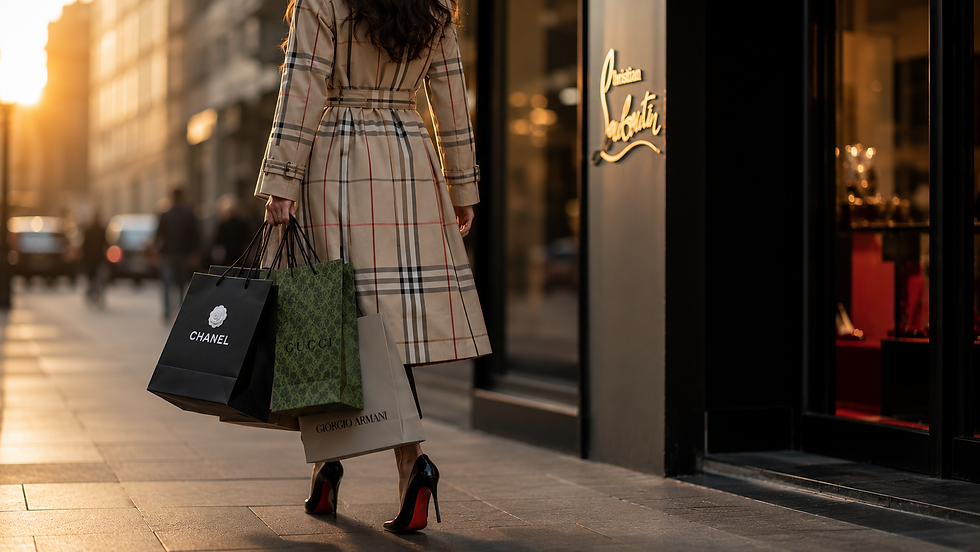
Many will argue that this is simply a matter of taste. And that is true, but only partly. The Logos consumer's taste was cultivated around a primary purpose: to communicate ownership publicly. The logo is the language. The brand is the broadcast.
What makes this consumer distinct from the Ownership consumer — with whom they are frequently confused — is the relationship with visibility. The Ownership consumer buys for the feeling of having. The Logos consumer buys for the feeling of being seen to have. These are not the same feeling. They are not the same consumer.
It is important to say clearly that there is no hierarchy here. The Logos consumer is not less sophisticated or less genuine in their relationship with luxury. They are simply operating from a different set of values. Their luxury is social. It is communicative. It is participatory.
What this means for brands is significant. The Logos consumer is your most vocal advocate. They will carry your name into every room they enter. But they are also the most sensitive to brand dilution. The moment your logo becomes too common or too available, it loses its signal value entirely. And they will move on.
THE INTERACTION
Here is what makes The Luxury Spectrum™ genuinely useful: these three consumer types do not exist in isolation. They interact. They overlap. They sometimes purchase from the same brand for entirely different reasons.
An Access consumer might wear a logo on a day they want to be recognised in a certain room. An Ownership consumer might buy something quiet when they want to feel rather than communicate. A Logos consumer might stretch toward something more restrained as their taste evolves.
The categories are not cages. They are tendencies. Primary orientations toward luxury that shape the majority of purchases, but never all of them.
The reason this matters for brands is that the same product can mean entirely different things to each of these three consumers. And a brand that markets as if it only has one type of buyer will always be leaving two thirds of its potential relationship on the table.
Understanding your consumer, really understanding them, is a strategic imperative.
WHAT IS COMING NEXT
Next on The Luxury Spectrum: the BRAND side.
Five levels. From Bespoke to Accessible. And the framework for understanding exactly where every luxury brand sits and whether their consumer agrees.
Follow along. The most useful part of this series is just beginning.
This is Part 2 of The Luxury Spectrum™ series.
Read Part 1 here: https://www.sleekwealth.com/post/the-multifaceted-guise-of-luxury

Comments