The Great Luxury Collapse of 2026, and Who Survived it Unfettered
What Q1 2026 earnings reveal about brand positioning and what most brands are still refusing to admit.
The Q1 2026 earnings season just handed the luxury industry its clearest lesson in positioning in over a decade.
Three of the world's largest luxury conglomerates reported in the same week of April 2026. LVMH, Kering, and Hermès. The verdict was not a sector crisis. It was a positioning crisis, marked as a sector crisis.
And the data makes that distinction impossible to ignore.
The Numbers
LVMH reported Q1 2026 revenue of €19.1 billion, down 6% on a reported basis, with a mere 1% organic growth.
Its stock fell 28% in Q1 2026 alone, the worst quarterly stock performance in the company's recorded history. Worse than 2008, or the pandemic.
Gucci, Kering's flagship, posted a 14.3% revenue decline in reported terms, dropping to €1.35 billion. On an organic basis, the decline was 8%.
Kering itself acknowledged in its earnings call what analysts had been saying for two years, Gucci's weakness stemmed from over-distribution and low cultural relevance, particularly in China.
The combined market capitalisation of LVMH and Kering has fallen by more than €100 billion since the end of the post-pandemic luxury boom in 2022.
Now look at the other side of the same market, with the same consumers, under the same macroeconomic conditions.
Hermès grew 5.6% organically in Q1 2026. Brunello Cucinelli grew 14% organically, with a confirmed growth outlook of 10% for both 2026 and 2027.
Same market, quarter, and geopolitical pressure. Completely different outcomes.
The Question Nobody Is Asking
Every earnings commentary blamed the war in the Middle East. The slowdown in China. Macroeconomic uncertainty. Currency headwinds.
These are real. They are not the story.
However, Hermès and Brunello Cucinelli operate in the same geopolitical environment. They sell to the same ultra high net worth consumer. They face the same currency pressures. And they grew.
The luxury brands that are suffering are the ones that spent the last decade chasing volume. More accessible price points, stockists, collaborations, visibility, and reach.
There is nothing wrong with marketing or expanding, only when it doesn't come at the cost of diluting positioning.
The brands that are thriving are the ones that never moved.
What The Luxury Spectrum™ Shows
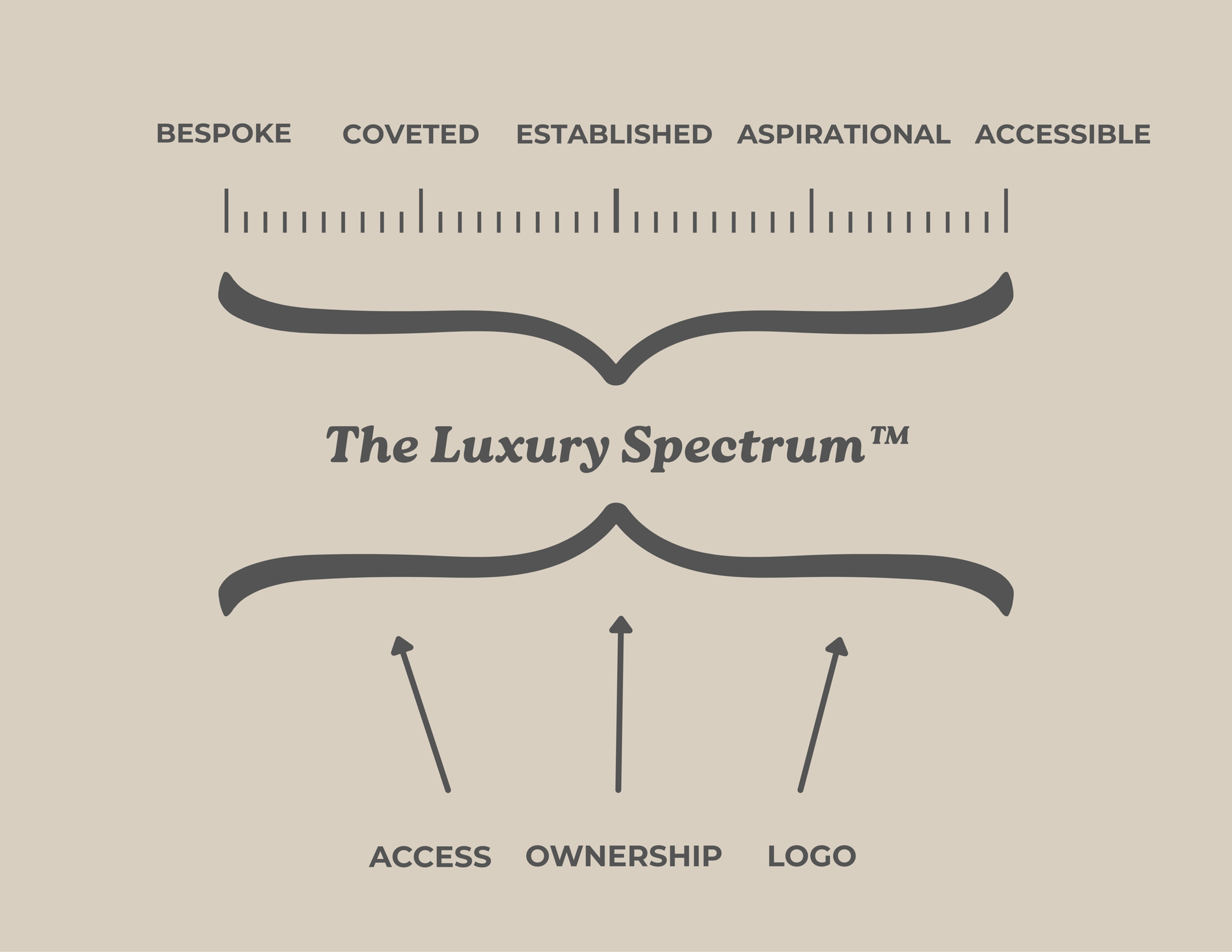
This is not a coincidence. This is The Luxury Spectrum™ in real time.
Gucci was a Coveted brand that slowly behaved like an Established one, and then like an Aspirational one. Each step downward felt like growth. More consumers. More revenue. More reach.
What it was actually doing was exhausting the very thing that made it worth wanting in the first place. The brand was everywhere and was therefore no longer perceived as something special anywhere.
Hermès never moved from Coveted. Brunello Cucinelli never moved from Accessible. But within that level, it has executed with such unwavering discipline that the brand has become the defining reference for what Accessible Luxury actually means at its finest.
The brands that know exactly where they sit on The Luxury Spectrum™—and make every single decision accordingly—survive everything.
The ones that don't become a case study in how quickly the market stops believing in you.
The Lesson
Kering's CFO said on the Q1 earnings call: “The recovery will be gradual. The fundamentals are being rebuilt in the right order.”
That is the language of a brand that has finally accepted it spent years building in the wrong order.
Positioning first. Always.
Distribution follows positioning.
Pricing follows positioning.
Communication follows positioning.
The moment a brand reverses that sequence, the moment it lets distribution or discounting lead the conversation, it begins a drift it may spend a decade correcting.
Gucci is correcting now. Under a new creative director. With a restructured product architecture. With a public admission of over-distribution.
That correction was entirely avoidable.
The brands that will lead the next decade of luxury are the ones making positioning decisions now with the same clarity that Hermès has maintained for the better part of a century.
The middle of the luxury market is collapsing. The top and the considered bottom are thriving.
That is not a market problem. That is a positioning verdict.
And the market delivers those without much warning and without much mercy.
The Blog.
Recent Posts.
The Fifty-Year Question. What the Gucci x L’Oréal Deal Really Says About Brand Control.
Three Shirts. One Acquisition. The Chanel x Charvet Deal Decoded.
Why Richemont Grew 20% While Everyone Else Collapsed.
In the World of Luxury, Discounting Is a Disservice.
The Five Types of Luxury Brands, And Why the Better Ones Never Fit Into Just One
The Fifty-Year Question. What the Gucci x L’Oréal Deal Really Says About Brand Control.
Three Shirts. One Acquisition. The Chanel x Charvet Deal Decoded.
Why Richemont Grew 20% While Everyone Else Collapsed.
In the World of Luxury, Discounting Is a Disservice.